

Here’s an opportunity to combine faith and art that many parishes could take advantage of: Eucharistic dramas. Never heard of them? Neither had I, but it’s time we learned.
Eucharistic dramas are a type of one-act play that flourished in Spain in the 1500-1600s, where they were known as auto sacramanetals. As a genre, the plays give the Eucharist centrality in the resolution of the dramatic action.
Christopher Rziha, a doctoral candidate of Spanish at the University of Notre Dame, has translated several Eucharistic dramas. According to Rziha, the dramatization prods the audience to contemplate the experience of God’s love. For example, the relationship between Christ and the Church is traditionally characterized in nuptial terms. A Eucharistic drama, by personifying the soul and Christ, shows the intensity of Christ’s love for us.
The point of the plays is to make accessible to a wide audience the joining of heaven and earth, the fusion of the divine and the human.
One of Rziha’s translations, The Phoenix of Love, by Spanish priest and playwright Jose de Valdivielso, was performed at Benedictine College in Atchison, Kansas, in March, 2025. Directed by Zachary Lulloff, the event was SRO.
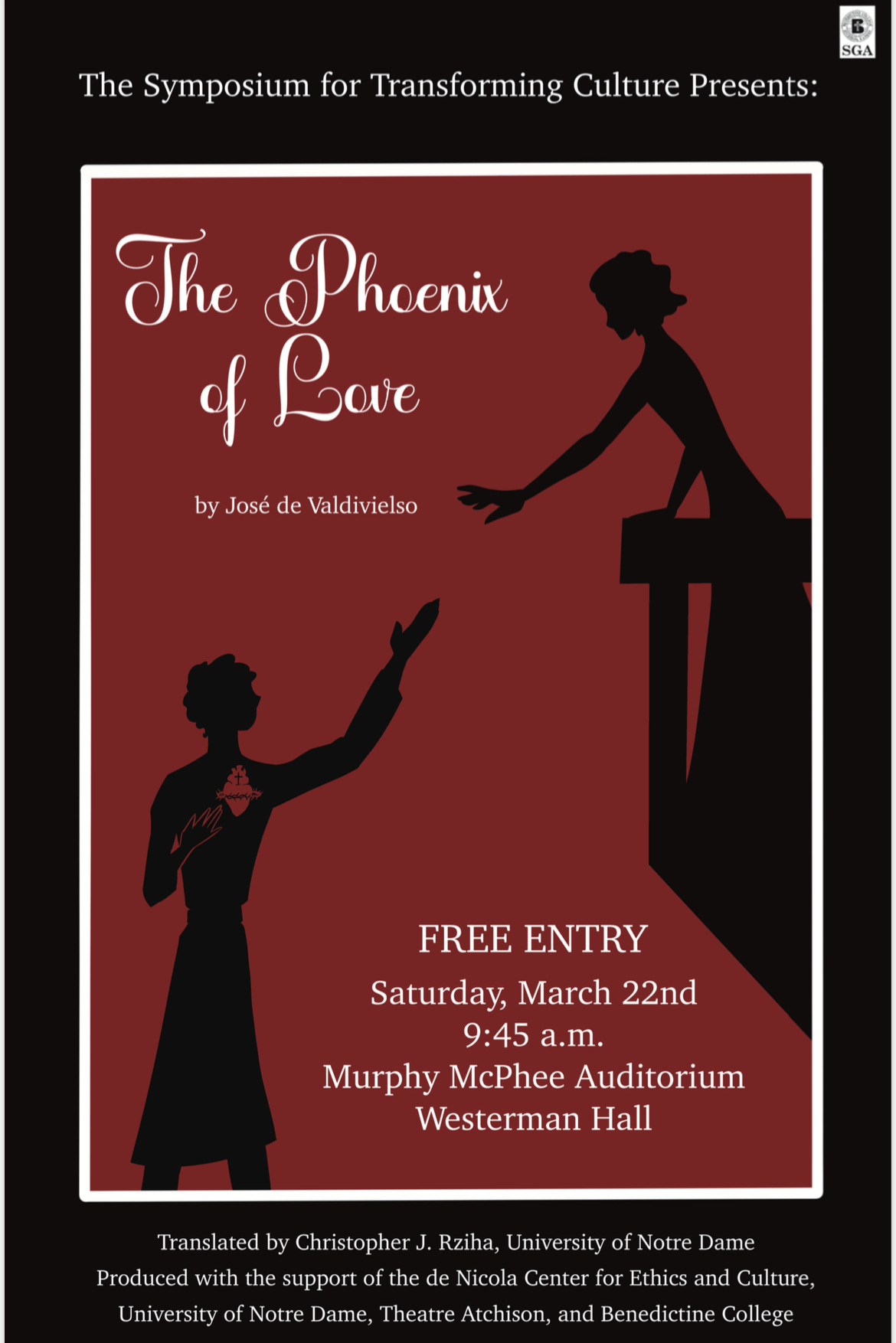
“Valdivielso saw theatre as a way of putting all of the different elements of human experience into the service of the celebration of the Eucharist,” Rziha explains.
Rziha has identified over 200 biblical allusions the play makes. “It’s important to realize the depth of formation required to write these sorts of plays,” he says. Rziha gave a version of the text with the biblical allusions to director Lulloff to provide guidance in bringing the text to life.
Lulloff and the cast worked to move the text from abstraction and relate the action to biblical and liturgical practices.

Rziha emphasizes how important prayer was to the cast as they rehearsed. “One of your cast members is playing Lucifer and, although it’s play-acting, it’s weird to go on stage and blast Jesus Christ for 200 verses in a row,” he observes. “There was a lot of prayer involved.”
Eucharistic dramas draw from medieval morality plays and so the characters tend to be personified qualities, e.g., “Inspiration,” “Soul,” “World,” etc. Despite the seriousness of the content, the works do not shy away from humor. Eucharistic dramas celebrate how the eucharist affects every aspect of our lives, from the simplest or even grotesque to the highest. “That’s the awareness that you have to approach these dramas with,” Rziha contends. “It’s a reverence that impels you to celebration.”
Rziha emphasizes that directors and actors should feel free to adapt the plays to their circumstances. That could mean dramatic readings vs fully staged and costumed performances or somewhere in between. It could also mean incorporating music and inviting audience participation. The plays were written at a time when there was no such thing as a published script and adapting scripts to local circumstances was expected.
What I think is exciting about this is that it’s a theological underwriting for drama as a “contemplative in action” (Rziha’s phrase) approach to the arts. “You have to approach this sort of work reverently with respect for the truths that it holds and recognize that part and parcel of those truths is to turn around and share them in as vibrant a manner as possible,” Rziha concludes.
Take an hour and enjoy the Benedictine College performance here.
Then drop a comment with your thoughts – and possibly your plans to stage a Eucharistic drama in your parish!
Visit Christopher’s site where you can access more of his play translations as well as his award-winning fantasy fiction.